
If you've searched online for "cheap GLP-1s" recently, the options can be overwhelming. One website promises semaglutide for $99 per month. Another advertises something called "oral tirzepatide" — FYI: as of June 2026, there is no FDA-approved oral tirzepatide, and these products are not equivalent to the approved injectable medications Mounjaro or Zepbound.
A third offers "research peptides" or "retatrutide shots." You might also encounter "GLP-1 patches," products that generally do not contain GLP-1 medications at all and instead typically contain various weight-loss supplements marketed under a new label.
Social media influencers share discount codes, online forums are filled with discussions, and telehealth companies all claim to offer the best solution.
For the average person, it can be difficult to know who to trust.
The reality is that many patients searching for affordable GLP-1 treatment are being pulled in multiple directions by marketing that emphasizes price but may not fully explain important differences in quality, regulation, manufacturing standards, and medical oversight.
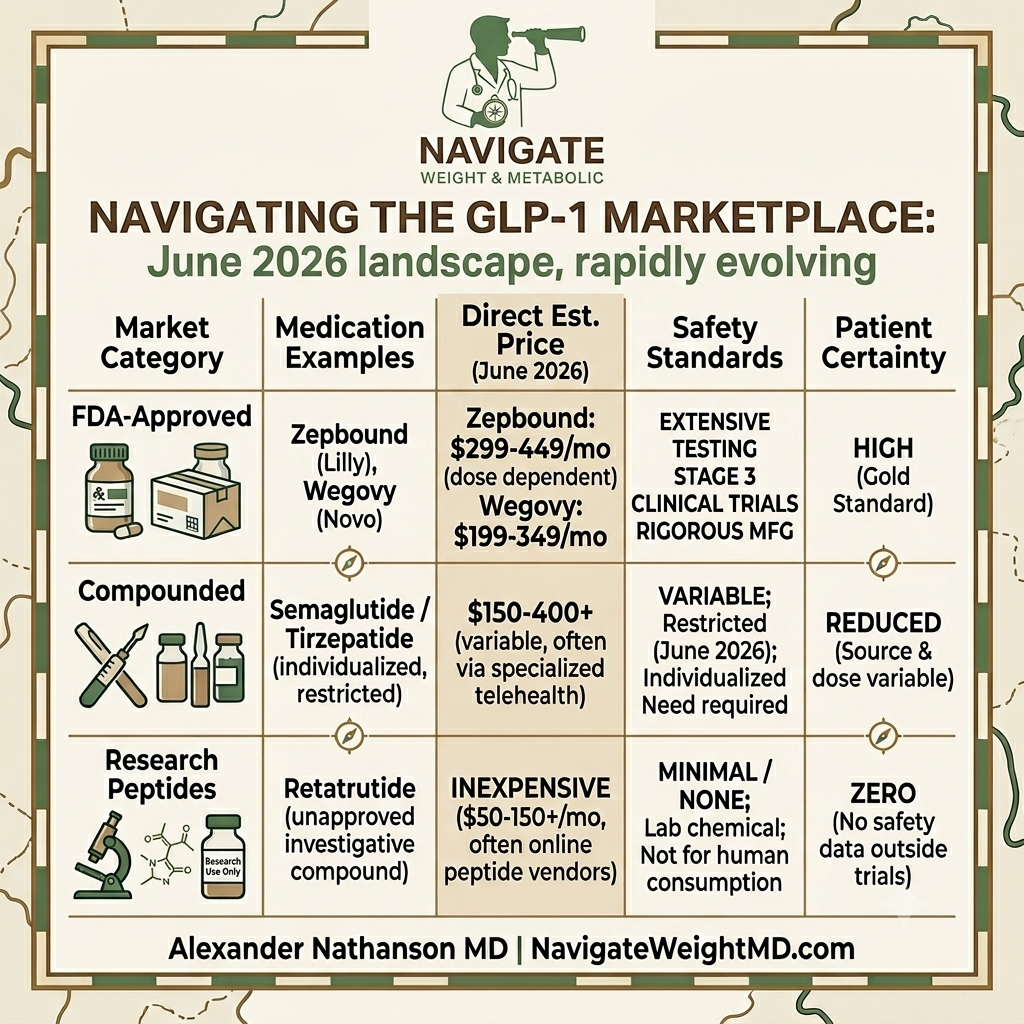
This article is intended to serve as a practical guide to the GLP-1 marketplace as it exists in June 2026.
Why Is the Marketplace So Confusing?
The confusion didn't happen by accident.
Beginning in 2023, demand for GLP-1 medications exploded. At the same time, many patients faced insurance denials, loss of coverage, or out-of-pocket costs exceeding $1,000 per month.
Patients did not turn to alternative sources because they preferred a less-regulated product. Most turned to them because FDA-approved medications were either unavailable, unaffordable, or both.
The combination of high prices, supply shortages, and growing public awareness created an enormous market opportunity. New telehealth companies, compounding pharmacies, peptide vendors, and online sellers rapidly entered the space.
The result is the marketplace we see today.
Option #1: FDA-Approved Medications
This is where I encourage patients to start.
FDA-approved medications such as Zepbound, Wegovy, Ozempic, Mounjaro, and Saxenda have undergone extensive testing for safety and effectiveness. They are manufactured under strict quality standards and supported by large clinical trial programs involving thousands of patients.
When you receive an FDA-approved medication, there is a high degree of confidence regarding:
What medication you are receiving
The dose you are receiving
How the medication was manufactured
The safety and effectiveness data supporting its use
For most patients, these products remain the gold standard.
Option #2: Compounded GLP-1 Medications
Compounded GLP-1 medications became extremely popular during the shortage era.
When FDA-approved products were difficult to obtain, compounding pharmacies stepped in to help meet demand—a role compounders have historically filled. Some developed strong reputations and helped many patients maintain continuity of treatment during a period of unprecedented shortages.
However, the compounding market has always existed in a different regulatory environment than FDA-approved medications.
Historically, concerns have included:
Non-standard formulations
Dosing confusion
Variable instructions and packaging
Questions regarding ingredient sourcing
Combinations with additional ingredients, such as vitamin B12
Importantly, the compounding market of June 2026 is very different from the market that existed during the height of the shortages. As shortages have largely resolved, large-scale compounding of semaglutide and tirzepatide has been heavily restricted by regulatory action. What remains is primarily individualized compounding for patients with specific clinical needs, often involving customized formulations or additional ingredients.
Patients considering compounded medications should understand that today's marketplace is evolving rapidly and may look very different than it did even one or two years ago.
Option #3: Research Peptides
The final category includes investigational research peptides.
These products are typically marketed with disclaimers such as:
"Research use only"
"Not for human consumption"
"Laboratory chemical"
Despite these disclaimers, many consumers purchase them with the intention of self-administering the medications.
Examples may include compounds such as retatrutide, a promising next-generation medication currently being studied in clinical trials but not yet approved by the FDA. While retatrutide has produced impressive results in clinical studies, commercially available products marketed as "retatrutide" are not FDA-approved medications.
The appeal is understandable. These products are often inexpensive and readily available online.
However, they also introduce the greatest level of uncertainty. Patients may receive:
No medical supervision
No pharmacist oversight
No assurance regarding manufacturing standards
No assurance regarding purity or potency
While these products are frequently discussed in online communities, they exist largely outside the traditional healthcare system.
What Many Patients Don't Realize
Many people still associate GLP-1 medications with monthly costs exceeding $1,000. That perception was understandable during the early years of the GLP-1 boom. However, the pricing landscape has changed significantly.
As of June 2026, manufacturer-sponsored cash-pay programs (e.g., LillyDirect and NovoCare) have made FDA-approved GLP-1 medications substantially more affordable than they were just a few years ago.
Depending on the medication and dose, FDA-approved options may now cost only a few hundred dollars per month.
For example: Injectable GLP-1 Medications
Zepbound: approximately $299–449 per month depending on dose
Wegovy: approximately $199–349 per month depending on dose and program
Oral GLP-1 Medications
Oral GLP-1 programs, including Oral Wegovy and Foundayo, currently range from approximately $149–299 per month
Pricing programs change frequently, and patients should always verify current pricing directly.
When platform fees, membership fees, consultation fees, and medication costs are added together, many alternative GLP-1 programs end up costing surprisingly similar amounts.
The marketplace is no longer simply a choice between a $1,200 brand-name medication and a much cheaper alternative. In many cases, the price gap has narrowed substantially.
So Where Should You Start?
When patients ask me where they should begin, my advice is simple: Start by exploring FDA-approved options first.
Many patients are surprised to discover that FDA-approved medications are more accessible than they expected. Ideally, patients should work with a provider who will explore potential insurance coverage. If coverage is unavailable, manufacturer-sponsored cash-pay programs may be worth considering.
An FDA-approved brand-name medication offers the most established safety profile, the most consistent manufacturing standards, and the greatest confidence regarding what is actually being delivered to the patient.
The GLP-1 marketplace has become increasingly complicated. Patients are confronted with advertisements, influencers, online forums, telehealth platforms, compounded products, and research chemicals all competing for attention.
My goal is not to criticize patients for seeking affordable treatment. The reality is that high costs and inconsistent insurance coverage created this marketplace in the first place.
Instead, my goal is to help patients make informed decisions. Whenever possible, I recommend starting with FDA-approved medications prescribed by a qualified clinician and dispensed through legitimate pharmacy channels. The difference in cost is often smaller than expected, while the difference in certainty, oversight, and safety can be substantial.