
Exercise and Protein Will Not Make You Lose More Weight on a GLP-1
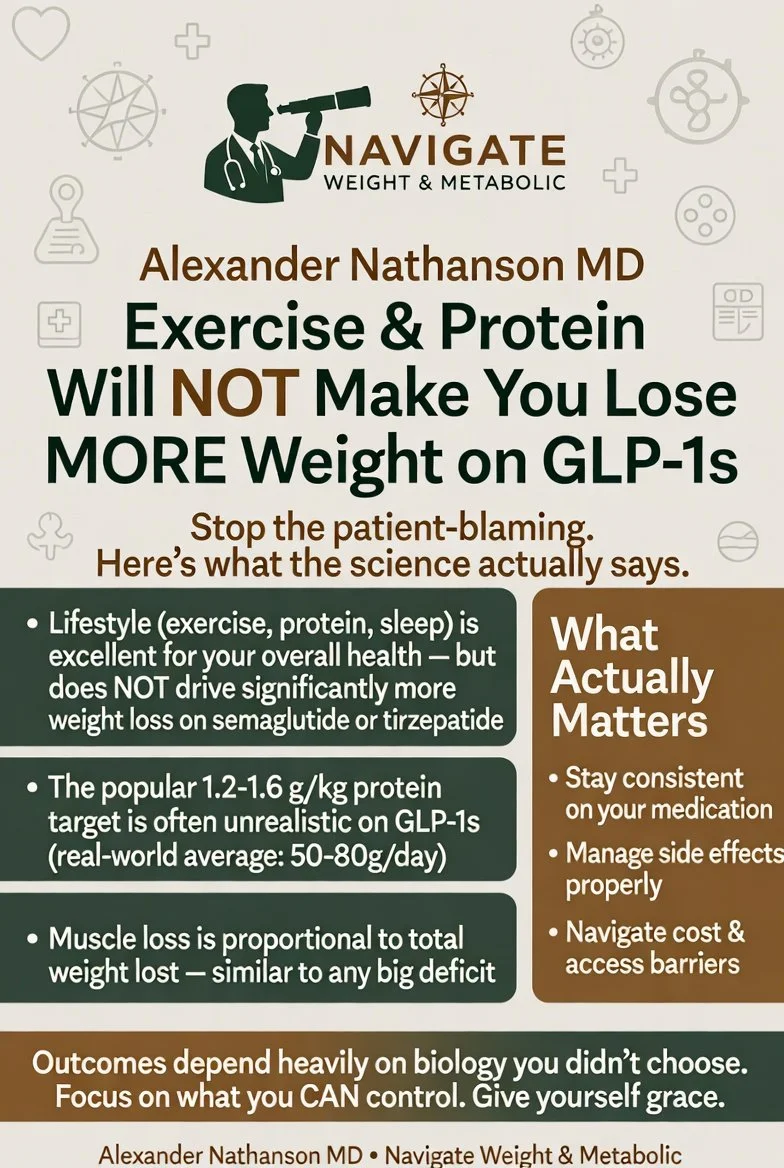
You should absolutely still prioritize exercise, protein, sleep, and stress management. These habits genuinely support strength, heart health, mood, and healthy aging.
But we need to stop the tired narrative that they are the main drivers of your weight loss results on a GLP-1. They aren’t. The idea that patients who don’t see dramatic results simply aren’t “doing enough” is the latest version of patient-blaming. It didn’t work before GLP-1s, and it won’t work now. I’m done with it.
This message comes from wellness influencers, fitness coaches, and even some board-certified obesity medicine colleagues who should know better. It usually sounds like: “If you’re not hitting your protein target and lifting weights, you’re being irresponsible.” Or “Your sleep score isn’t optimized.” Or “Have you tried managing your cortisol?”
Stop. We spent decades telling people with obesity they just weren’t trying hard enough. We don’t get to move the goalposts now that effective medications exist.
The actual science
Will optimizing protein intake make you lose more weight on semaglutide or tirzepatide? No.
Will resistance training meaningfully improve your total weight loss trajectory? Also no.
We lack strong RCT evidence for either claim in the GLP-1 context.
The often-repeated 1.2–1.6 g/kg protein target comes mostly from older pre-GLP-1 studies in people with normal appetites and moderate deficits. On a GLP-1, the drug deliberately slashes hunger, and many patients drop to 1,000–1,500 calories or fewer. Real-world data shows average protein intake often falls to just 50–80g daily — because the medication is working as intended. For a 100 kg patient, 120–160g per day is a large, frequently unrealistic amount without forcing food or supplements in ways that worsen nausea and early satiety.
Resistance training has decent evidence for preserving strength and function — especially in older or frailer individuals at risk of sarcopenia. These tools can support the quality of weight loss (better fat-to-lean ratio and functional outcomes). That matters. But the messaging often conflates this with total scale results, leaving poor responders feeling like their suboptimal outcome is their own fault for not training hard enough.
Muscle loss: facts vs. fearmongering
Muscle loss occurs with any substantial caloric deficit and is generally proportional to total weight lost on GLP-1s. It is not a unique or disproportionate danger of these medications. Lifestyle tweaks can help protect strength and function for those who tolerate them, but viral warnings overstate the risk and understate how much biology (age, sex, baseline muscle, etc.) matters.
What actually drives results
Response to GLP-1s follows a typical bell curve. On a population level, the strongest predictors are largely outside individual control:
Better responders tend to be:
Younger
Female
Without type 2 diabetes
Weaker responders tend to be:
Older
Male
Living with diabetes (especially long-standing)
Genetics, metabolic phenotype, and other factors we don’t fully understand also play major roles. This makes many people uncomfortable because it doesn’t sell supplements, programs, or easy content. But it’s the reality.
The same old story with new language
For decades, obesity was framed as a failure of willpower: just eat less and move more. GLP-1s finally acknowledged the biological reality — dysregulated appetite signaling, metabolic set points, hormonal factors. The blame didn’t disappear; it evolved. Now you’re on the medication… but you must do it the “right” way with heroic protein targets, lifting, and optimized wearable metrics.
“Irresponsible” is the new stigma
Telling patients it’s irresponsible to use a GLP-1 without obsessing over protein grams, lifting schedules, sleep scores, and cortisol creates a perfect unfalsifiable trap:
Great results = the drug + your optimization
Poor results = you didn’t try hard enough
This isn’t evidence-based medicine. It’s moral judgment.
What lifestyle factors actually do — and don’t do
Exercise, protein, sleep, and stress management are good for your health. Pursue them at a sustainable level for those real benefits — not because they’re magic levers for dramatically better weight loss or requirements for “responsible” treatment. The constant blurring of quality weight loss with overall success has created unrealistic expectations and unnecessary guilt.
What actually gives you the best chance
The single biggest modifiable factor is staying on the medication consistently. Focus there.
Real clinical priorities:
Proper side effect management (nausea, fatigue, GI issues) with slow titration and good provider support
Overcoming systemic barriers: cost, insurance denials, shortages, access
These issues — not skipped leg day or missed protein targets — drive most discontinuations.
Bottom line
Don’t let anyone suggest you’re not optimizing enough. GLP-1s offered a chance to move past the idea that obesity and its treatment reflect a failure of character or effort. Outcomes depend heavily on factors you didn’t choose.
Focus on what you can control: consistent use, working with a knowledgeable provider on side effects and access, and sustainable habits that actually improve your life. Give yourself grace on the rest.
Patients deserve the truth, not another round of moving goalposts. We’ve been down this road before. Let’s do better.